The Bust of Emperor Vespasian Typifies Roman Portraiture Traditions in Art Quizlet
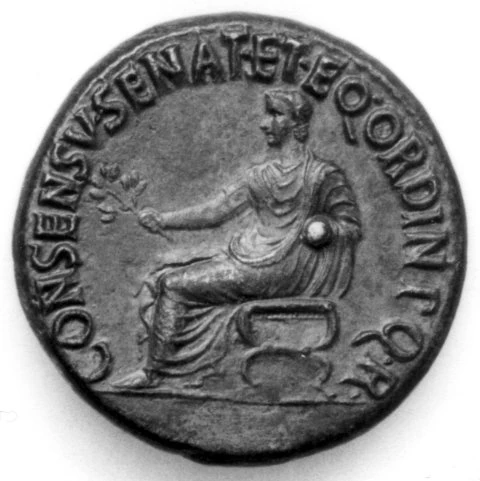
Caligula Seated on Chair
Portraits of Caligula: The Seated Figure? (Caligula the Outset Living Princeps to Appear Radiate)? Joe Geranio
Photograph Courtesy F. Shmutz Bern Historical Museum Fig ane.
Introduction: The purpose of this study is to identify the revese figure on the consensv dupondii (See coin portrait on this folio of seated figure of dupondius) , struck during the reign of the Princeps Caligula. In that location has been much controversy over this reverse type, which, along with portraits in the round of Caligula, will exist examined in some depth. Through numismatic, literary and epigraphical show I will written report the seated figure, which has been traditionally accepted as Augustus, and not Caligula. Was Caligula the beginning living Princeps to exist shown radiate on coinage and not Nero as commonly believed? Backround
Gaius Julius Caesar Germanicus was built-in in A.D. 12. His birthplace was most probably Antium (mod day Anzio).1 He won his nickname Caligula or "lilliputian kicking" (caliga) by way of the army, because he grew up among the troops and wore the miniature compatible of a private soldier. According to ancient biographers Caligula'southward physical features were unusual and far from handsome. Seneca, a gimmicky of Caligula, writing after the Emperor's death, described him in this way: "So repulsive was the whiteness of his face, which showed mad escapades, so haggard were his eyes hidden under his brow, which like that of an old man, and and then large was the repulsiveness of this baldness of his head which was only partly covered with hair, his legs were thin and his enourmous."2 While this type of evidence is helpful for an idea of Caligula's general appearance, it is not useful for understanding of what Caligula may have actually looked similar. Images on the coinage of Caligula, therefore, will become an important part of bringing the portraiture of Caligula together, besides as iconographical and literary evidence. Portraits tend to depict Caligula equally the idealized Julio-Claudian Princeps. Caligula placed bully importance on his famous family, and and so begins the work of a propagandist. On coinage struck during Caligula's reign we find a pattern of well-thought-out imagery on both the obverses and reverses of all of his coinage. Most notably-and what this study attempsts to recognize- is the seated effigy on the reverse of the consensv dupondius.3 In the historical Museum of Bern. The Bern piece is clearly meant to represent Caligula, and non Augustus, equally has been believed for many years by numismatists and scholars of art history.4
Distribution and Destruction of Portraits
Start let us examine how imperial portraits may have been distibuted throughout the empire. For the production of imperial portraits exterior Rome, F.H. Swift has suggested that standard types of cannons, originating in Rome in authoratative works, were sent out in dirt or waxen models to exist reproduced in monumental form in the provinces. These models, he believes, were unremarkably known as imagines. Furthermore, M. Stewart has suggested that communitites outside of Rome, imported their portraits of the majestic family unit fix-made from the nearest provincia art middle. His conclusion is that distribution of imperial portraits throughout the empire was effected privately through channels of the fine art trade.5 Identifying portraiture of the Julio-Claudians is often hard given the many members of the family and familial similarity (non to mention intentional immitation and absorption of features).6 Identifying portratiture of Caligula can be hard because, upon his death, the senate wanted to order damnatio memoriae, or the removal of all caligulan portraiture-an order the Emperor Claudius "officially" opposed simply secretly canonical. Coins that caried the unpopular portrait were melted downwardly past decision of the senate. At that place is an instance of a mutilated small bronze portrait of Caligula,7 every bit well a numerous coins struck during Caligula'south reign where the praenomen C (ie. Gaius) has been chiseled off.eight Countermarks common in other principates rarely occur on the coinage of Caligula. For instance, the countermark NCAPR from the mid-Neronian period tin can found on sestertii from the reign of Tiberius through the reign of Claudius, only is never establish on bronze coinage with Caligula's image.9 On some of Caligula'south Vesta aeses the countermark TICA does appear to obliterate the praenomen C (ie. Gaius) Caesar. Of course, the statement for demonetization can be fatigued from the scarcity of coins institute in hoards which deport Caligula's portrait. For example in Pozzarello hoard near Bolsena, 719 copper and orchicalcum coins from the republic to Nerva were institute, but no aeses of Caligula in any denomination (this as well applies to precious metals).ten At Bredgar in Kent, R.A.Thousand. Carson associates this hoard with the Claudius invasion of 43.
The aureii found in this hoard are as follows:
Tiberius............... 19 Claudius............... 4 Caligula................ 0 (note 11)
In a numismatic seminar held at U.C. Berkeley on coins in sanctuaries, R. Stroud found further proof of demonetization. Speaking on Roman coins establish in the sanctuary of Demeter at Corinth, Stroud listed similiar results:
On Corinthian Duoviri Coins:
Reign of Augustus............ 12 Augustus/Tiberius............ four Caligula.......................... 0 Claudius......................... 1 Nero.............................. 2 Galba............................. 7
On Roman Imperial Coins:
Julius Caesar.......................1 Augustus............................three Tiberius..............................i Caligula..............................0 Claudius.............................1 Nero..................................1 (note 12)
In that location is still, however, no clear consensus on whether demonitization was carried out. An immediate and total recall would inappreciably have been practical, since there was no de facto damnatio. On the other hand, Claudius may have wanted, near likely for personal reasons, to erase whatsoever retentivity of the hated Emperor.thirteen
Inscribed Portraits
Of the xv remaining inscribed portraits of Caligula, only five can exist dated with any accuracy, and merely ii of them to the years before 37 A.D. when Caligula became Emperor.14 One, from Calmna in Asia Small, dated to A.D. 18 when Caligula travelled to Asia Minor with his male parent Germanicus;xv one, from Vienna, dated to the year A.D. 33; and thre from after A.D. 37.(16) We know that Caligula gave the Greeks permission to erect six statues of him:17 I each in Delphi, Isthmia, Nemea and Olympia; and two in Athens.xviii These portrait inscriptions are too few to offer any reliable conclusions. However, the fact that two of the 3 datable inscriptions are from A.D. 37/38 may suggest the production of his portraits was greatest at the outset of his reign.
The Portraiture of Caligula
For portraits in the round we will study busts that accept been well established as beingness Caligula, too as portraits that agree iconographically with the consensv dupondius in the Historical Museum of Bern. Nearly portraits of the Roman princeps that have survived are replicas of majestic commissioned prototypes that are now lost. The images of Caligula represent the style the princeps wished to be portrayed. Despite his reputation for dementia and lunacy, it would exist counterproductive if Caligula wanted to expect demented in his portraiture.19 Among the finest portraits of Caligula in beingness is the caput in Shloss Fasanerie, most Fulda, Federal republic of germany.
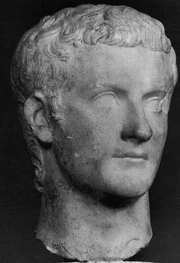
Caligula from Fulda Schloss Fasanerie
xx In this example nosotros can see where a false sense of dementia can be attributed to Caligula. Perhaps a youthful emperor type, the head is 37 cm. loftier, slightly damaged and was made to join a togate effigy. Although the hairstryle resembles that of Tiberius, the fulda head clearly has the physiognomy of Caligula. Bear in mind that while Caligula's predecessors were of onetime historic period late into their principates, portraits are idealized and youthful in style. Such is the case with Augustus and Tiberius. Caligula, on the other hand, being youthful, was portrayed in a youthful way, but with a torvitas that enhanced his seriousness. Therefore, we find a sure seriousness to his portraits that, at times, tends towards severity or an appearance of dementia. Since Caligula became Emperor at historic period 24, the seriousness of his portraits obviously fuelled imperial propaganda and was soemthing the young princeps wished to convey. Another example of this tin be seen in the head in Copenhagen from Asia Pocket-sized. In this portrait of Caligula we discover qualities of both the "autocrat' type and 'accession'type. Quite apparent are the wide cranium, hollow temples, high forehead and narrow mouth with protruding upper lip (all consequent with a more serious portrait, and one which represents the Princeps at the end of his reign). The pilus, however, is fuller, more layered and deeply undercut, showing signs of the more than youthful accession type. There seems to exist a pronounced asymetry to the Copenhagen head, a fact which has acquired scholars to propose the Emperor looks demented. Only if nosotros expect closely at this portrait it is not dementia we run across, but a fact of preservation. Roman marble heads were originally painted,21 and remnants, however faint, are clearly seen in the eye sockets of the Copenhagen head. The result is thus misleading. From these two heads nosotros can draw some general characteristics of a Caligula portrait in the round: hollowness of the temples (which can vary from portrait to portrait), a sloping or vertical brow, deeply set optics, hair curls low on the nape of the neck, eyebrows tending to angle upwards course the inner to the outer corner of his eyes, a bulbous nose, and a pocket-sized rima oris with a protruding upper lip. His lips are as well usually thin, and his hair forks at the center and is brushed to one side or the other.22 I other portrait of Caligula worth studying is the caput establish in the Worcester Art Museum, located in Massachusetts. Some scholars have suggested this piece was made postumously, and possibly dates from Neronian times.23 The contour of the Worcester caput looks very familiar to the Vesta aes which will be discussed later. An essential method for distinguishing the Julio-Claudians from one another is to examine the design of locks of hair beyond the forehead. Since nearly surviving sculptured heads are not found with their inscribed bases, their identificaton can only exist determined by a resemblance to other inscribed portraits, especially those on coins. This raises questions equally to how portraits by die engravers were copied. Did die engravers copy unique or special portrait medallions, rather than portraits in the round? Most probable non, as ultimately die engravers would have needed some portrait model in the round. Of class the challenge is attempting to identify an uninscribed portrait in the round every bit we are forced to do with Caligula. I have recently found an unpublished portrait of Caligula? that the scholars were unaware of, it resides at (Fig. Baie Caput) the Museo Archeologico dei Campi Flegrei in Baia.
The Coinage of Caligula
Caligula's coinage is ane of the near interesting and innovative of the Julio-Claudian period. The most controversial question apropos his principate involves the moving of the mint for precious metals from Lugdunum to Rome. When did this occur? Strabo, writing nigh A.D. 18, states that imperial aureate and silver were minted at Lugdunum, and his assertion receives some support from inscriptions, which bespeak the presence of individuals connected with the mint at Lugdunum early in Caligula's principate.24 By the Trajanic period, however, the minting of gilt and silver at Rome is attested on inscriptions, and the homogenity of precious metal and aes bug has been traced back to the time of Vespasian. Therefore, the minting of aureate and silver coinage was transferred to Rome at some betoken between Tiberius and Vespasian. It has long been argued that the transfer of the mint of Rome is to be dated early in Caligula's principate.25 This theory (proposed by Mattingly) rests on a bones feature of Caligula'south early coinage. Coins issued betwixt March, A.D. 37 and March, A.D. 38 accept an obverse blank head. Some issues in this menses (and all later years) have an obverse laureate head, indicating a change in the pick of blazon during Caligula'southward first year, one that is accompanied by slight changes in the letter forms. This is seen as an appropriate bespeak for the change of mint. Sutherland has pointed to other differences in the way of heads, and reinforce Mattingly's theory, although he does concede that changes could be explained past the appointment of new staff at Rome.26 Recently, nevertheless, the weight of scholarly stance seems o have moved against the notion of a change of mint under Caligula. In particular, J.B. Girard has drawn attention to the discovery at Parlay-le-Mondial (Saone-et-Loire) in Gaul of two dies for precious metallic coins of Caligula, each with laureate heads, and has associated one with coins minted as late as A.D. forty. Girard believes that these dies represent the remains of the mint of Lugdunum and that the equipment was looted and scattered around the boondocks. Mattingly has recently observed that the dies on golden and silver (unlike his aes) remain unadjusted theoughout Caligula'sreign, and started to become adapted subsequently Nero's currency reform in A.D. 64. (27) Likewise worth noting are the AV quinarii, the just precious metal coins struck during Caligula'southward reign that tin be dated between April A.D. 38 and January A.D. forty. This coin provides evidence of a breaking tradition, that Caligula held consulship in every yr of his reign except A.D. 38. His dies imperii was March 18 A.D. 37. Like Tiberius before him, Caligula refused to have the praenomen imperatoris.28 On the coins struck during the reign of Caligula, there are 3 images of the Emperor that are non merely busts.29 The first is a sestertius which shows a pietas on the obverse, facing left with a patera (libation dish) in her hand; in the exergue the inscription PIETAS.30 Backside her stands a pocket-size figure of unknown identity and significance. On the reverse, is a hexastyle temple decorated with festoons, and figures on pediment and cornice; in the foreground stands the Emperor Caligula, veiled with patera in one hand, facing lleft, in the human action of sacrificing on an chantry, to which the slaughterman is dragging a bull. A 2d Acolyte stands behind Caligula. The design is flanked by the inscription DIVO AUG SC. The sestertius is from the Rome mint. The temple befoe which the sacrifice is beingness conducted has been iidentified as that of the Divine Augustus. This money'southward high llevel af artistic accomplishment places it deeply amid the historical sculptures of the Julio-Claudian period (and iincidentally constitutes one of the earliest know examples of historical relief on a Roman coin).31 Thesecond example is the adlocutio cohortis sestertius.32 This type is completely original as information technology is the first depiction on coinage of an majestic spoken language to the army. The coin more than probable represents Caligula's donative to the praetorians on his accession (although H.W. Ritter believes that its reissue was continued with the episode of the briege at Baiae, at which the praetorians were nowadays).33 As S.C. does not appear on this money, it may have been a special event for the praetorian guard. The obverse bears legend C(aius) AUG (ustus) GERMANICUSPON(ifex) M(aximus) TR(ibunica) POT(estate), and shows the head of Caligula, laureate, facing left. The reverse reads: ADLOVT(io) COH(ortium). and shows Caligula, togate, continuing on a platform, extending his mitt to five armed soldiers, of whom each soldier in the two rearmost pairs carries an aquila. Perchance the most interesting coin of all, however, is the tertiary one, the much debated dupondius which depicts a seated figure believed by many to be Caligula.34 Prompting this decision is the unmistakable resemblance of the seated figure's head to the obverse portraits on Caligula's Vesta aes. It is reasonable to presume that the Vesta aes is the main money that all portraits in the round of Caligula should resemble. In his book Die Bildnesse des Caligula, Vol.4, D. Boschung displays eight different photos of the Vesta aes with slightly different styles of obverse portrait type.35 Information technology is articulate from these comparisons that Boschung understands the importance of the Vesta aes iconographically, and that the Vesta aes is the best reference to the Bern dupondius iconographically.36 So what portraits in the circular would hold with the profile imagery of the Vesta aes, every bit well as the consensv dupondius in profile imagery are the Worcester caput and the Getty caput. Of course the Bern dupondius is on a much smaller calibration than the Vesta aes but still merits closer test. The Worcester head bears the most iimpressive resemblance to Caligula iconographically. Presumably constitute virtually Marino,37 Information technology has been suggested that this marble head was postumously created in Neronian times. However, in profile and iconography, it clearly resembles both the Vesta aes and the seated figure on the Bern dupondius. Traits of Calilgula which nosotros take established are credible on this piece: Hollow temples in the forehead, a wide Claudian cranium, deep fix optics, a narrow chin, and the locks over the forehead are fuller. Other Caligulan traits in resemblance to the aes and dupondius are the slightly bulbous nose, vertical or sloping forehead and protruding upper lip. The hair does not go down the nape of the neck quite as far every bit hair on the aes and consensv dupondius, merely this head is well preserved and may be the most representative in-the-round prototype of the Emperor Caligula in being.38 The Getty head,39 made of fine-grained marble, 41 cm. high, is said to accept been from Asia Small-scale, only, equally Johansen suggests, the style of this caput is non provincial, most probable, information technology was made in Rome or elsewhere in Italy and exported to Asia Minor. The Getty head, nevertheless, was non fabricated postumously, simply most probably shaortly after Caligula's accesion. It, As well, closely resembles the aes and consensv dupondius iconogrpahically, and must be considered as an essential portrait in attributing Caligula's portratiature. The hair falls downwards the nape of the neck further than on the Worcester head, and the forks at the heart of the forehead, a common occurence in Caligulan portraiture. One final aspect of the seated figure of Caligula on the consensv dupondius is worth examining. Could Caligula have been the commencement living princeps to e'er announced radiate on Roman coinage? B.East. Levy. in her article entitled "Caligula's Radiate Crown," finds traces of a radiate crown on ii pieces: One in the Princeton University Library; the other in a private collection. Some scholars believe this theory strengthens the statement that the seated figure is Augustus and not Caligula. H.M. Von Kaenal advanced this estimation of the dupondii this way: His first argument is that on some of the reverses you could identify Caligula'south features; secondly, that the reverse legend iis suited to certain events of his accesion. As Dio tells us, the event was altered past an erruption into the senate- house of equites et populus,xl and in Von Kaenal's view it is to this, and not the award of an honorific statue, that the fable CONSENSV SENAT ET EQ ORDIN P Q R must refer.41 H. Kuthmann brings even stronger show of the opposite type not being Augustus when he suggests that on pre-Flavian coins the curule chair is the seat of the living princeps, while that of DIVUS Augustus is a throne.42 This is strong evidence that the seated figure is that of Caligula. (Interestingly, Kuthmann identifies the seated figure as Claudius.) Co-ordinate to Von Kaenel the portraits of Caligula on the aureii and denarii are all in correct profile; those on sestertii, dupondii, and asses are all in left profile. Von kaenel concludes that all of the imperial issues reproduce a single official portrait blazon and that what variations exist are of a stylistic and not of a typological nature. Furthermore, since the two contour views are not mirror images, Von kaenel suggests that they faithfully reproduce the left and correct side Respectively of a unmarried model in the round and he believes that comparison with marble replicas of Boschung's "Haupttypus" ostend the same master "vorbild" lies behind both the sculptured and numismatic replicas. Co-ordinate to von Kaenel, the Roman die engravers were provided with either a single caput in the round to serve equally a model for their miniature profile portraits or with two split up relief portraits corresponding to the left and right sides of a sculptured head of Caligula'due south "Haupttypus." This is an important ascertainment and information technology would be interesting to know if it is typical of Roman numismatic portraiture for left- and right facing portraits of the same person to be rendered differently or whether the coinage of Caligula is exceptional in not employing mirror images.43
Caligula the Start Living Princeps to Appear Radiate? Levy brings farther evidence to low-cal when she suggests that the bronze provincial issues of at least three or 4 mints show Caligula with radiate attribution (i from Alexandria, simply this issue may stand for Helios.)44 Some other event from the province of Asia shows a spikey Hellenistic crown.45 Fifty-fifty stronger show that the radiate crown did exist can be seen on consensv dupondii , where the die engraver shortened the vertical bar on the T in ET to accomadate the crown, while the entire letter T is slightly raised in the 2d Princeton piece. Levy mentions that the radiate crown is neglected in descriptions which follow illustrations in catalouges. In specifically looking for the radiated crown on the consensv dupondii, There are at least three problems that have been found via the art merchandise.46 Information technology has been suggested that the radiate crown is occasionally used on Roman coinage to distinguish a newly elevated Emperor. Thus, the Roman radiate crown was non a true piece of insignia: Its significant was flexible and its use optional.47 Fig () of Close up of Princeton piece and smaller dupondius
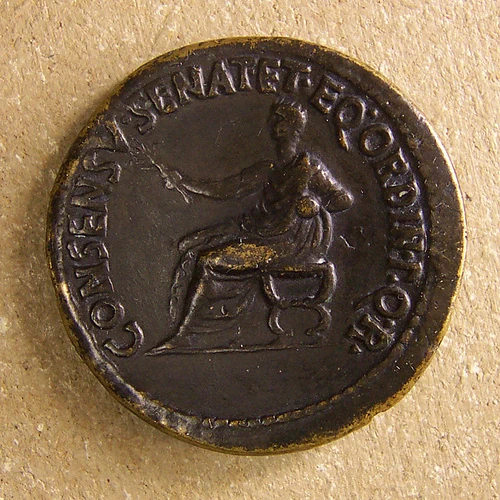
Caligula Shown Radiate?
Decision and Evidence
Levy stated in a letter to me: that she would alter the last paragraph of her commodity (Caligula's Radiate Crown), for she now thinks the radiate crown on that coin (and she meant to take said just "rays") was the sort of thing the occasional die-cutter might have put in, She didn't hateful equally an error, but a sort of optional detail. I experience as Levy suggests, that a few CONSENSV dupondii with radiate effigy on the reverse came at the get-go of the issue, and the pattern was later modified in deference to public opinion. And so once again every bit Levy suggests, and I disagree; we might set them every bit belatedly, seeing in them a manifestation of Caligula'south gradual self-exaltation, which is well attested in the literary sources but otherwise absent from his coinage.48 (That is, in view of how few have turned upwardly, it is rash to say the rays constituted an official element of the initial issue, later discontinued). I respectfully disagree and see the CONSENSV dupondius and provincial coinage equally radiate attributions. Through public stance the radiate attribution was disbanded. I believe the CONSENSV dupondii was originally meant to have radiate attribution. I hope as time goes on to show more than CONSENSV dupondii with radiate atributions.
Levy has communicated with von Kaenel, and he suggested through a letter to Levy that, von Kaenel states "We might suspect this if the Radiate pieces were irregular in other ways, only the style to von kaenel seems perfectly Roman". Yard. Bergmann on p.129 of her massive "Dice Strahlen des Herrscher." In a long footnote argued the rays on the Princeton dupondius were a modern addition, tooled on by someone who wanted the seated figure to look more than like Augustus. Of form she'd merely seen the photo in SM. The CONSENSV could not have been tooled as to how many I personally have seen up shut and personal.
It has always been recgonized that Nero was the get-go living Princeps to announced radiate? This in my stance is a falsehood. In the provinces there are examples of Caligula shown radiate which pre-dates Nero. Fig (IONIA, Smyrna. Gaius (Caligula). AD 37-41. Æ 14mm (2.xiv g, 12h). Radiate head right; star behind / Crab. Klose XXVII B (V7/R15); RPC I 2474; SNG Copenhagen 1347; BMC Ionia 279 (aforementioned dies). PHRYGIA, Aezanis. Gaius (Caligula). 37-41 AD. Æ 20mm (5.20 gm). Lollios Klassikos and Lollios Roufos, magistrates. Radiate head correct / Zeus standing left, holding eagle and sceptre. RPC I 3085; SNG Copenhagen 80. Was the radiate crowns of Caligula's Greek coinage routine to exact flattery at his accession. Nero had the same situation on his coinage, and information technology may exist significant that the start representation of the latter with radiate attribution comes equally early as 56/57 A.D. on the reverse of an accesssion issue at Alexandria (Fig Nero) Dattari 12-13 200-203. Eygpt issued no regnal coinage until his third year (56/57 A.D.) This may be considered an accession type. This clearly puts Caligula as the first living Princeps in my opinion to exist shown radiate non only on Provincial coinage, but; in my humble and controversial view the CONSENSV dupondii was meant to testify a radiate attribution. I have already mentioned the reasons why the radiate CONSENSV was disbanded. The radiate crown he wears on the coinage signifies that he is descended from Divus Augustus -- same for Nero, only he could claim kinship with both Divus Augustus and Divus Claudius.
End Notes
+ I should like to thank Prof. John Pollini, Dean of the School of Fine Arts at the University of Southern California, for his help in locating many materials on the portraiture of Caligula. I should also similar to give thanks Brooks Levy at the Princeton Umiversity Library for insightful views on Caligula'south radiate crown. Many cheers to the Classics Department at the University of California at Berkeley for their scholarly seminars on numismatics, peculiarly Prof. R. Stroud and Prof. R. Knapp. I am also thankful to the San Francisco Ancient Numismatic Society, and thanks to Susan Forest for her help in in finding material on the portraiture of Caligula. Lastly I would similar to thank Miriam Griffin for her encouragement and the beginning volume she suggested on the Julio Claudians. Bibliography 1. Suetonius, Cal 8.i: Fasti Vallenses and Fasti Pighiani; also run into Dio 59.61. A Barrett, Caligula: The Corruption of Ability, Yale University Press, 1989 (Barrett 1989), while not rejecting Suetonius, raises questions, pp.half dozen-vii, Too run into J.P.Five.D. Balsdon, The Emperor Gaius, Oxford, 1934 (Balsdon 1934), p.4.
ii. Seneca, De Constantia Sapientis, p.18. Encounter also Suetonius, Calig. p. 50.
three. BMC I 160/88-92: RIC I 56; AE dupondius. Obverse: Augustus radiate caput left. Reverse: seated figure on curule chair holding co-operative and globe. Attribution to the reign of Caligula now seems sure. See H. Chantraine, Dice Antiken Fundmuzen Von Neuss, Novaesium Eight, 1982. pp. 20-21.
4. (supra north. three ); The seated figure has been accustomed by most scholars as Augustus, the description of information technology as an honorific statue apparently goes back to I. Eckhel, Doctrina Numorum Veterum VI, 1828, p. 126. Also see B.E. Levy, "Caligula's Radiate Crown,"Schweitzer Munzblatter, 38/152, 1988 (Levy 1988), pp. 101-107, Besides run across H.Grand. von Kaenel, "Augustus, Caligula oder Claudius," Gazette Numismatique Suisse 28, 1978, pp. 39-44. As Levy points out a fuller investigation into: 1st century and Hellenistic evidence would be rewarding. E. Kantorowicz, Oriens Augusti, Dumbarton Oaks Paper 17, 1963, 119-133, examines the association of solar imagery with royal accessions and epiphanies. Unfortunately it starts with the 2nd century A.D.
5. Swift, F.H., "Imagines in Royal Portraiture," AJA 28, 1923, pp. 286-301. G. Stewart, "How Were Royal Portraits Distributed Throughout The Roman Empire?" AJA 43, 1939, pp. 601-617. J. Pollini, The Portraiture of Gaius and Lucius Caesar", New York, 1987 (Pollini 1987), pp. ii-3 for a photograph of a terra cotta head in the Louvre, see Kiss, L'iconographie, figs. 312-13, p. 99.
vi. Fullerton, M.D., Rev. of Pollini 1987, AJA 92, 1988, pp. 615-17, probably the almost difficult of the Julio-Claudians to attribute; an insightful review. Also come across R. Brilliant, "An Early Majestic Portrait of Caligula," AAAH 4, 1969, pp. xiii-17. Too see J. Pollini, "A Pre-Principate Portrait of Gaius (Caligula)?" JWAG, Vol. 40, 1982 (Pollini 1982), pp.three-4. I believe this portrait that Pollini speaks of is indeed the only pre-principate likeness, which is similiar to the Dresden and La Spezia Portraits.
7. DioLX22. Likewise run into M. Bergemann and P. Zanker, "Damnatio Memoriae'-Umgearbeitete Nero und Domitians Portrats: Zur Ikonographie der Flavischen Kaiser und des Nerva," jdI 96, 1981, pp. 317-42. See besides J. Pollini, "Damnatio Memoriae in Stone: 2 Portraits of Nero Recut to Vespasianin American Museums," AJA 88, 1984, pp. 547-66. For a photograph of a mutilated small statuary of Caligula, see F. Johansen, " The Sculpted Portraits of Caligula," Ancient Portraits in the J. Paul Getty Museum, Vol. i, 1987 (Johansen 1987), figs 19a-19b. For a portrait of Germanicus mutilated in late artifact, Come across S. Walker, Roman Fine art in the British Museum, 1991, fig. 33, p. 31. For the greatest work to date on Caligula in the circular. See D. Boschung, Die Bildnisse des Caligula", Das Romische Herrscherbild, Vol. 4, function 1, Berlin 1989 (Boschung 1989), no 30, pls. 27, 1-4, 45.ane.
8. Jonas, E., " A Damanatio Memoriae alkalmazasa egyik duponiusan Caligula, Numizm Kozlony, 1937-38, pp. 89-91.
9. Barrett 1989, pp. 179-80. D.W. Mcdowall, " THe Economic Context of the Roman Royal Countermark NCAPR," Acta Numismatica I, 1971, p. 87.
x. Callu, J.P. and F. Rosati, "Les Depot monetaire du Posarello," MEFR, 1964, pp. 51-90.
11. Carson, R.A.Grand., "The Bredgar Treasure of Roman Coins", NC, 1959. pp.17-22.
12. Seminar held at the University of California-Berkeley. Apr 1995, Berkeley Classics Department.
13. Barrett 1989, p. 180.
14. Stewart, M. (supra n. 5), pp. 601-17.
fifteen. IGR 4, 1022.
sixteen. CIL XII, 1848, 1849.
17. Dio LIX.four IG VII, 2711.
18. IG, 2nd ed., vols two-3, 3266-67. Athens together with Drusilla; Graindor, BCH 38, 1914, no. 18, p. 401. Seyrig, RA, 1929, p. 90. See as well T. Pekary, Monumentum Chiloniense, Amsterdam, 1975, p. 107. Eastward. Koberlein, Caligula und die agyptische Kulte, Meisenheim am glau, 1962, p. 54.
19. Poulsen, Five., "Portraits of Caligula," A Curvation 29, 1958, pp. 175-ninety. On the Worcester caput, Poulsen speaks about "an unmistackable nervous tension," For a description of the so-called "crazy Caligula portrait," meet D. Kleiner, Roman Sculpture, New haven, 1992, p. 128. See besides J. Pollini, Roman Portraiture: Images of Character and Virtue, Los Angeles 1990, pp. 8-12.
20. For more than on the Fulda caput, run across Johansen 1987, p. 95. Poulsen (supra n. 19), pp. 178-79. See also H. Heintze, Die antiken Portrats in SchloB Fasanerie bei Fulda, Mainz, 1968, no. 21.
21. Copenhagen head 637a : Th pupils, eylashes and irises were added in paint; merely those on the left of the Copenhagen head are still preserved. Come across Kleiner (supra north. 19), p. 127. J. Pollini told me in conversation that the Docents at the NY Glyptotek like to scare the children with the so called "Crazy looking Caligula"
22. Pollini 1982, pp. two-4.
23. Poulsen (supra due north. xix), p. 186. Johansen 1987, p. 106. Kleiner (supra northward. 19), p. 126. All concur that the Worcester caput is as possible postumous result from Neronian times.
24. A very controversial outcome. Meet Strabo, 4.3.ii; CIL Xiii (supra n. x), pp. 1820, 1799.
25. Mattingly, BMC cxiii-iii.
26. C.H.5. Sutherland, " The Mints of Lugdunum and Rome under Caligula: an unsolved problem,"NAC 10, 1981, pp. 297-99.
27. Girard, J.B., "les emmisons d'or et d' argent de Caligula dans l'atelier de Lyon," RN, 1976, pp. 69-81. At that place is a danger that these were forgers's does. Run across also H.M. von Kaenel, " Die Organasation der Munzparagung Caligulas," SNR 66, 1987, pp. 42-43. H.B. Mattingly, NC 145, 1985, p. 256; Barrett 1989, pp. 244-54.
28. Balsdon 1934, p. 146.
29. On the other imagery of Caligula, see locally produced glass medallions thought to bear Caligula's image from the Rhine area, see D. Boschung, Romische Glasphalerae mit Portratbusten," BJ 187, 1987, nos. 2,seven, 27. For convincing identification of the seated male figure on a gem in the Vienna Kunsthistoriches Museum, every bit Caligula and non Augustus, meet H. Kyrieleis, "Zu einem Kameo in Wien," Archaologischer Anzeiger, 1970, figs. 1,three, pp. 492-98. Pollini 1982, p. 3. For pre-accretion portrait of Caligula on colonial issues from Carthago Nova in Spain (commonly crude portraits), see A. Banti and Simonetti, Corpus Nummorum Romanorum 13, Florence, 1977, pp. 141-50.; M Grant, Aspects of the Principate of Tiberius, New York, 1950, 35, 101, pl. six.3.
30. RIC, 36.
31. Breglia, 50., Roman Imperial Coins: Their Fine art and Techniques, 1968, pp. 44-50. Likewise see Kleiner (supra n. 19), pp. 141-63; Boschung 1989, p. 18.
32. RIC I, 110, no.32.
33. Ritter, H.Westward., Adlocutio und Corona Civica unter Caligula und Tiberius," JNG, 1971, pp. 81-96.
34. This identification was already made in the auction catalouge, Munzen und Medaillen, AG Basel 43 (12-13.11.1970), no. 289.
35. Boschung 1989, pl D, Figs. 1-8.
36. Boschung 1989, pp. 24-25; H.K. von Kaenel (supra n. 4), pp.39-44.
37. Poulsen, V. (supra n. 19), p. 185; Johansen 1989, p. 104.
38. For discussion for the typology in identification of Caligula. Run across Pollini 1982, pp. 1-12.
39. Johansen 1987, p. 97. Probably made before long later on Caligula's accession, this caput I accept seen personally at the J. Paul Getty Museum. A most impressive head from Asia Modest. See Pollini 1982, p. 6.
xl. Dio 59.6.one; Suet Calig. 14.1. Also see A Jackobson and H. Cotton, Caligula's Rescusatio Imperii, Historia 34, 1985, pp. 497-503.
41. Grenade, P., Essai sur les origines du principat, 1961, p. 283.
42. Kuthmann, H., "Claudius, Germanicus und divus Augustus," JNG 10, 1959/60, pp. 56-57. 43. Kleiner, F.American Journal of Numismatics three-iv New York (1992): Review of D. Boschung's 'Dice Bildnisse des Caligula' Gerbruder-Mann (1989)
44. Smallwood, E.M., Documents illustrating the reigns of Gaius, Claudius and Nero, 1967, no. 126. Also see K. Charlesworth, CAH X, 1952, p. 654, nt. 1; G.J.D Aalders,"Helios Gaios," Mnemosyne thirteen, 1960, pp. 242-43.
45. BMC 145/ 49-51.
46. First, I accept come up across at least (as of 5/15/06) nine known examples of Caligula radiate?(I hope y'all realize it is caligula). Here is function of the theory: The Die-Cutter for some reason has shortened the "T" in ET' for some reason. Could it have been that this was to make room for the rays? For 1 piece where the crown is quite evident see: Itemize of the Vierordt sale Shuluman 5.3 1923, no. 573. A. Banti and L. Simonetti has considerable samples in CNR VI (1974) 65-72. It's strange when you are non aware to look for something you lot don't see it! My eyes now scan the Consensv dupondii very closely. Sometime the "T" is delibretaly raised, but information technology always seems to be raised to a sure degree. The signal regarding Caligula being the seated figure is obvious, since the curule chair is the seat of the living Princeps earlier the Flavian era. The best portrait, which I have is a photo of Caligula (iconographically) in the Bern historical Museum. We can't assume becasue the die-cutters abberations . When we look at provincial coinage nosotros clearly find Caligula radiate during his principate. Did the proposed radiate crown = divine election? Could this attribute come at the beginning of the issue and then pressure from Rome discontinued it? Or was the radiate added later on with Caligula's cocky exaltation? ON THE Diplomatic mission TO GAIUS THE First Office OF THE TREATISE ON VIRTUES (De Virtutibus Prima Pars, Quod Est De Legatione Advertizing Gaium) Philo (95) Afterwards, when he thought fit to exercise and so, he laid bated these ornaments, and metamorphosed and transformed himself into Apollo, crowning his caput with garlands, in the form of rays, and holding a bow and arrows in his left hand, and holding along graces in his right, as if information technology became him to proffer blessings to all men from his fix shop, and to display the all-time arrangement possible on his correct mitt, but to contract the punishments which he had it in his power to inflict, and to allot to them a more confined space on his left. There is a very like case in Flavian coinage, a sestertius issued for Titus at the beginning of his reign (BMC 178-81). The contrary shows Five. and T. holding a globe between them; the head of i figure, on some but not all preserved examples, has very small rays. Information technology'due south always been thought this was Vespasian, simply for numerous reasons must be Titus. As with Caligula, this detail defines him as the emperor-elect. The radiate crown he wears on the coinage signifies that he is a descended from Divus Augustus -- same for Nero, only he could claim kinship with both Divus Augustus and Divus Claudius.
47. Levy, B.Eastward., " Portraits of the Heir Apparent: Geta or Caracalla," AJA, 1992, p. 350; B.E. Levy, Calpurnius Siculus/ I 84-88: The Iconograhy of Imperial Succession," APA, 1989, p. fifteen. 48. R. Fears, ANRW 2.17 (1981)72, note 347. Run into as well Zanker, Paul, Provinzielle Kaiserporträts: Zur Rezeption der Selbstdarstellung des Princeps, Munich: Bayerische Akade- mie der Wissenschaften, 1983 Boschung, Dietrich, "Die Bildnistypen der iulisch-claudischen Kaiserfamilie: ein kritischer Forschungsbericht," Journal of Roman Archaeology half dozen (1993)
Source: https://ancientrome.fandom.com/wiki/Roman_portraits
0 Response to "The Bust of Emperor Vespasian Typifies Roman Portraiture Traditions in Art Quizlet"
Post a Comment